
How and where to sell my company?


how-and-where-to-sell-my-business-in-mexico-anepsa

By J. Alfredo Gutiérrez • Certified Appraiser | Updated: June 2026

Table of contents

The market for buying and selling companies in Mexico

3rd place
Mexico in the M&A ranking in Latin America
After Brazil and Colombia — a market in sustained growth since 2021
+400
M&A transactions registered in Mexico per year
Average 2022–2024 · middle market segment
8–14 m
Average time to close a business sale
It depends on the size, sector, and tax complexity.
3–7×
Average EBITDA multiple for Mexican SMEs
It varies by sector, size, and level of accounting formality
28%
The M&A transactions are in manufacturing and industrial sectors.
Driven by nearshoring · most active sector 2023–2025
15–30%
Higher selling price with advisor vs. direct negotiation
The difference that justifies the cost of an M&A broker
60%
The SMEs sold in Mexico did not have a prior valuation
Undervaluation: the most costly mistake a seller can make
Sources KPMG M&A Trends Mexico 2024 · Deloitte Mergers & Acquisitions LATAM · IMEF · Mergermarket · Anepsa Engineering, internal data 2023–2025

How and where to sell my company?
Making the decision to sell a company is a step that entails a lot of work and internal processes within it, in order to ensure that everything is in order, is transparent and meets the requirements that a buyer needs for the transfer or acquisition of this 

From your place as a seller and owner of a company, it is important to remember that the value you perceive of the company may not be correct, therefore it is necessary to hire an expert appraiser to know the real value.

And in this process of putting the information for sale in order, the area heads must be included, with the purpose of obtaining reports on the current status of each department and other data that we will talk about below.


What is a business transfer?

It is the transfer through a rights assignment contract of all tangible or intangible assets and liabilities that make up and are owned by the company, in exchange for a monetary sum based on the financial statements and economic history of the company in question. It can be the total sale of a company or part of it, such as shares. 

Before this, the Law requires sellers to be informed about the possible sale and have their prior approval to continue with the transaction. 

The most common in these cases is to request the transfer due to lack of time to attend to the business, retirement, due to illness of the owner, economic need, or simply to be able to invest in another existing or owned business, among many other factors. 


Types of business transfer 

When selling a business, the lease agreement for the premises is usually transferred as well. In Mexico, there are several ways to do this, and almost all of them have one thing in common: require the landlord's consent, unless the contract already authorizes it (Federal Civil Code, Arts. 2480 and 2481). These are the most frequent cases:

    • Assignment of lease agreements: A new tenant takes the place of the previous one and assumes their rights and obligations towards the landlord. 
    • Transfer due to death: The contract does not end with the death of the tenant: the heirs continue with the same terms (Art. 2408).
    • Subletting of business premises: The tenant allows a third party to occupy the premises, in whole or in part, while maintaining responsibility to the landlord. 
    • Transfer to a company: Being the owner of the premises or business can only be transferred, that is, leave someone else in charge to become the tenant of the same. 
    • Transfer due to corporate restructuring: In situations such as merger, division or transformation of another type of company. 
    • Transfer with sale of stock or debt: In addition to the premises, inventories, equipment or other business assets are transferred, or the new tenant assumes debts of the previous one.

How to sell my company?: An 8-step process for selling my company

1
Decision making

The starting point is the conscious decision to sell. The reasons might be retirement, a need for liquidity, corporate conflicts, a change in strategy, or simply an attractive offer. Clearly defining the reason helps in choosing the best type of transaction and the ideal buyer profile.

First step
2
Define the type of sale

The board of directors is evaluating the possible options: total sale of assets and liabilities, sale of shares (partial or total), transfer with the workforce, merger, or strategic acquisition. Each option has different tax and legal implications with the Mexican Tax Administration Service (SAT) and the Mexican Social Security Institute (IMSS).

Strategic
3
Review the internal structure

With the support of each department head, pending processes, current contracts, internal and external debts, the status of the workforce, and the condition of fixed assets are reviewed. The goal is to hand over the company in good order and without hidden liabilities that could affect the price or the closing process.

Operation
4
Collect financial information

The financial statements for the last 3 to 5 years are compiled: balance sheet, income statement, cash flow statement, SAT tax returns, and EBITDA reports. This information forms the basis of the valuation report and the Information Memorandum that will be presented to potential buyers.

Critical
5
Collect legal information

Articles of incorporation, current permits and licenses, lease agreements, contracts with employees and suppliers, registered intellectual property, and powers of attorney. Along with the financial information, this forms the basis of the business summary that will be provided to buyers under a non-disclosure agreement (NDA).

Legal
6
Certified professional valuation

A certified appraiser determines the true value of a company using methodologies such as Discounted Cash Flow (DCF), market multiples, or net asset value. This supporting document provides certainty to both the buyer and the seller and is required for transactions formalized before a notary.

Anepsa Key
7
Buyer search and negotiation

An M&A advisor pre-selects qualified buyers (strategic or financial), manages NDAs, and conducts the due diligence process. Negotiations balance the needs of both buyer and seller: price, payment terms, warranty clauses, and closing conditions.

M&A
8
Legal closure and operational transition

The purchase agreement is formalized before a notary public and registered in the Public Registry of Commerce. The seller provides a cooperation period for the new owner to become familiar with the operation: key aspects of the business, customer relationships, and the transfer of strategic information.

Notary · SAT
Ready to start the process? Our certified experts will guide you from valuation to closing.
Contact an advisor

Where to sell my company?

Putting a company up for sale involves a different process than selling any other product or service. It requires contacting a mergers and acquisitions (M&A) advisor, who acts as an intermediary between the seller and the potential buyer. Their role includes providing financial advice and, in this case, facilitating the sale of shares or the entire company. They will also assist in selecting potential buyers beforehand and may be present during negotiations.

In other cases, the services of a commercial broker may also be required, who will also be a representative of one of the two parties involved in the sale and conducts the negotiation based on prior agreements with their clients, never on their own behalf.

In our country, it's common to need intermediaries to successfully complete this transaction. They can handle competitor analysis and contact potential buyers or business owners. Keep in mind that this process takes time: rushing it increases the risk of not getting the right price.

Improving the company can be one way to increase its value. Thinking like the buyer is an obvious but very useful strategy; typically, a buyer focuses on the following aspects:

  • A fair and supported commercial valuation, carried out by a company and a certified expert for the valuation of the same, that provides an accurate and clear analysis of the factors on which it was based to conclude a final value.
  • Financing tools for the company, from equity swaps to supplier financing.
  • Factors that put the company at risk: In any investment, the conditions of the industry, the market, the economic situation of the country where it is marketed, the growth potential, liabilities and assets, debts, credits, etc., must be examined before the purchase.
  • To find a buyer, the traditional approach is to spread the word within the industry, among acquaintances, suppliers, and partners. You can also seek the assistance of advisors such as accountants and lawyers, who often know potential buyers and can act as intermediaries.

Some of the options for announcing the sale of the company
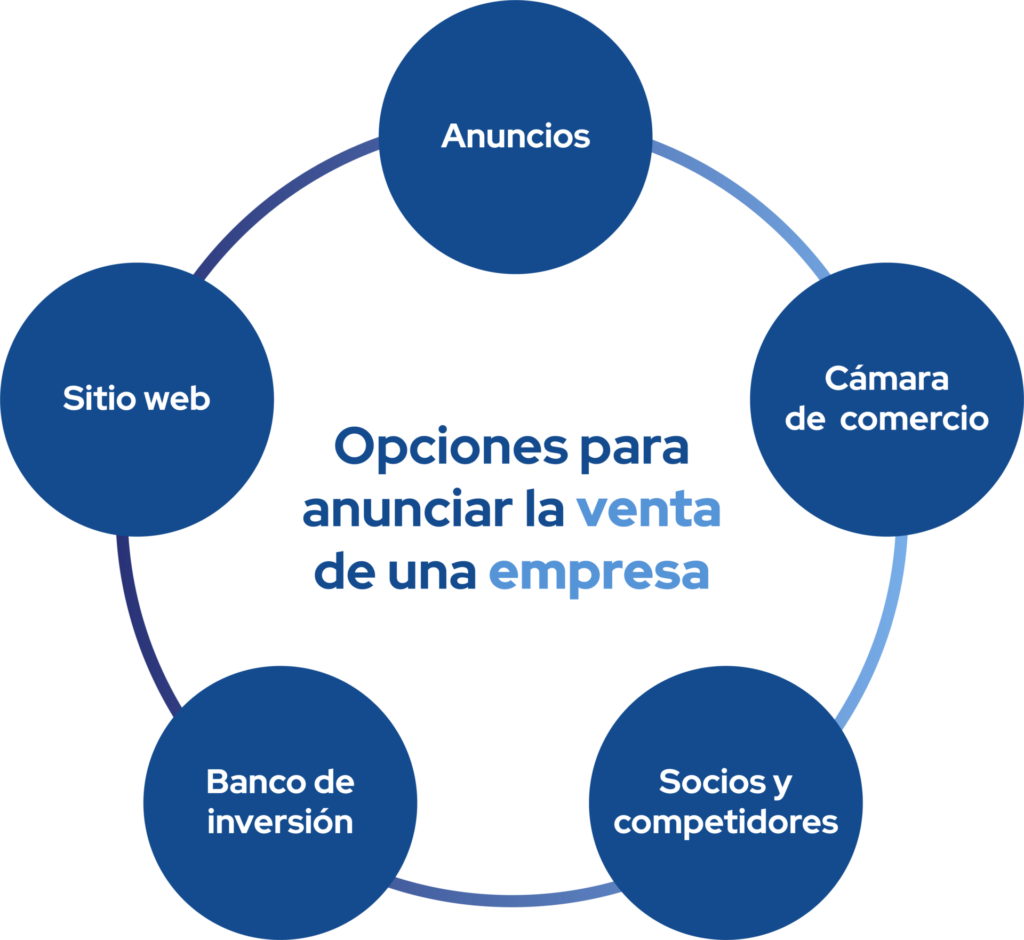
Options for advertising the sale of a company
  • Advertisements in local media, with a massive audience.
  • Local Chamber of Commerce: Through its network, it can assist with sales and finding potential buyers.
  • Acquaintances, business partners, competitors, and buyers: it can be the widest and most far-reaching network.
  • Investment bank.
  • Online listing websites, where potential buyers can be filtered and selected.

Why sell my company?

There are various reasons to sell a business, ranging from the entrepreneur's personal circumstances to market factors. Some of the most common are:

Liquidity

Liquidity: When you sell the company, you receive a sum of money that is often used to invest in another business or company.

Uncertainty

Uncertainty: Not having a good structure, administration or staff, or conflicts between partners, generate distrust about the future and lead to opting for a sale.

Strategy or convenience

Strategy or convenience: For reasons of growth, expansion or strategic alliances, you can choose to sell shares and add new partners.

Need for investment or capital

Investment or capital need: The company may go through a period of low profits and a need for cash flow, so selling is considered when the necessary resources are not available or when investing own capital is not desired.

Successors

Successors: In some businesses, one generation creates them and the next makes them grow; over time, the owners and management change, and sometimes the business stops yielding the same results, which opens the possibility of sale or transfer.

Conflict between partners

Conflict between partners: Personal problems between owners often affect the smooth operation of the business; in these conflicts, a sale by one or both parties is usually the best solution.

Technology

Technology: Technology evolves daily, and businesses evolve with it. When a company fails to evolve, it can become obsolete and require investment to maintain its market share and profitability. If the owner is unwilling to make that investment, selling to new owners or a larger company with those resources is considered.

What is the sale of shares? 

This type of transaction is much more common and in many cases more convenient in multinational companies, since it involves the sale of a percentage of the company for an established amount of money that is paid to each shareholder of the company for which, the buyer assumes all responsibility and risk that being part of the company entails.

Generally, income from the sale of shares is not subject to tax, except when the shares are acquired with the purpose of being sold in the short term. 

When concluding with the sale of shares, there is the advantage that the business does not change ownership, the relationship with employees is not affected and the business continues with its daily activities, in addition to the fact that the capital obtained benefits each one of them. shareholder members of the company. 

We mention some advantages and disadvantages from the point of view of the seller and the buyer regarding the option to buy and sell shares:

Advantages
Seller
You do not lose the business in its entirety.
It has the option to repurchase its shares in the future, if this was the initial agreement and both parties agree.
Buyer
You can be part of the shareholders' council depending on your percentage of participation.
Return on investment with the profitability of the company.
Disadvantages
Seller
You have to consult and vote on decisions about the direction of the company with the council or board of directors.
It is mandatory to be listed on the stock market and this is very volatile.
Buyer
The value of those shares may also decline.
Taking on responsibilities often also brings with it legal actions, scandals, debts, etc.

What do I need to sell my company?

After verifying that the requirements for the sale or transfer of the company are met and analyzing the pros and cons with the help of all the previous information, it is necessary to consider that a professional in the field will be needed to prepare a company purchase and sale agreement, depending on who the owner is, since it can be a natural or legal person, and in which the respective transfer of shares and an inventory of the elements transferred in this sale must be established, as well as invoices or receipts to prove ownership of the assets.

After the signatures are finalized, a copy of this must be printed for each party involved (buyer and seller) or the parties involved in the case of a sale of shares, and finally, if the company belongs to a legal entity or corporation, it is necessary to formalize said contract by means of a public deed, which means delivering it with a notary or public broker and making a registration in the Ministry of Economy regarding the sale.

What legal and tax obligations are involved in selling a company in Mexico?

Before closing any purchase or sale transaction in Mexico, it is essential to consider the obligations to three key institutions:

SAT (Tax Administration Service)
The sale generates income tax on the profit. For asset sales, it is calculated on the difference between the sale price and the tax value. For stock sales, income tax is applied to the capital gain. A CFDI (electronic invoice) must be issued for the transaction, and the taxpayer's RFC (taxpayer identification number) must be updated or canceled as appropriate.

IMSS
In the event of a complete transfer, the employer substitution procedure applies (Article 290 of the Social Security Law) — the new owner automatically assumes all obligations to the employees, who retain their seniority. If the employees are not transferred, they must be compensated in accordance with the Federal Labor Law.

Notary and Public Registry of Commerce
For legal entities (SA, S. de RL), the transaction must be formalized before a notary public and registered in the Public Registry of Commerce. The notary fee ranges from 11% to 21% of the transaction value.

Actual timeframes to consider:
The entire process from the decision to the legal closing takes between 6 and 18 months in Mexico, depending on the size and complexity of the company.

How does a going concern appraisal work to sell my business?

When a business is operational and generating cash flow, its value is not limited to its physical assets: it also includes its profitability, customer base, and market position. Therefore, a going concern appraisal It is the obligatory starting point before any purchase and sale negotiation in Mexico.


Anepsa Mexico

SME Appraiser Mexico PRO

Mexican market multiples · June 2026 · MXN

🇲🇽 Results in Mexican Pesos (MXN)

A going concern valuation is a study that considers tangible and intangible fixed assets such as:

Tangibles
Valuable physical assets
furniture and equipment
Computer equipment
Machinery and equipment
Estate
Mineral deposits, etc.
Intangibles
Non-physical assets of value
Brands and trade names
patents
goodwill
Customer lists and business relationships
Franchise
computer software

And they are analyzed to know the value of each one of them since the business is visualized as a whole made up of said assets. 

In this type of appraisal, both economic factors of the business environment must be taken into account, as well as the financial one in which it is carried out, for which reason this study provides the businessman with a concise idea of his financial situation, which allows measuring the profitability and liquidity of the business.  

Commented on the above, the study of going concern valuation It is the main tool for the sale of your company, since as we mentioned in previous points, knowing the real value of your business based on specific and verifiable data will be what motivates the purchase and can support the price at which it is offered. 

Tips to sell my company 

    • Planning the exit of the company one or two years in advance will help put the company in optimal conditions for sale, improve sales so that the value is higher, have the necessary financial records, customer and personnel database, etc
    • Getting a business broker ensures maximum value for the business.
    • Qualify potential buyers, thus having the opportunity to analyze whether the business will be safe or not, since many buyers make the deal but are waiting for a loan and when they do not obtain it, the sale falls apart, analyzing each of the possible buyers we can rule out those that are accurate and those that are not. 
    • Have a succession plan, if the personnel template will be transferred, the seller can prepare in advance a person from the organization or its area heads with complementary training that proves the operation of each area and thus can advise the new owners on the operation of the company. 
    • Increase in the value of the company before the sale, with an action plan to increase the value of the assets, sales and profits or the improvement of facilities, staff training, increased production, etc. 

Useful pages if you are in the process of selling your company

Valuation of ongoing businesses, companies, real estate, guaranteed and supported by expert appraisal experts.

On this platform you can find more than 4,900 businesses for sale, filtering by geographic location, budget and sector

Platform to announce or search for the transfer of a company according to the city or country where you require it and the business, without the need for intermediaries.

Advice for the sale of your company.                    

To learn more about the valuation of companies consult our blog or contact to one of our advisers and solve all your doubts.

How to sell my company? A comparison of methods

Direct Sales Digital Platform
★ RECOMMENDED
M&A Broker / Advisor
Cost / Commission Free 1–3% or fixed fee 3–8% of the final value
Average time Indefinite 6–18 months 4–12 months
Network of qualified buyers ◑ Limited ✔ Extensive and verified
Confidentiality of the process ✗ High risk ◑ Partial ✔ NDA Protocol
Professional valuation included ✔ Yes
Support in negotiation and due diligence ✔ Complete
Tax compliance SAT / IMSS ✗ Legal risk ◑ Partial ✔ Consulting included
Ideal for companies with EBITDA Less than $1M MXN $500K – $5M MXN $1M – $100M+ MXN
Direct Sales
The owner manages the process
CostNo commission
TimeIndefinite
BuyersWithout a qualified network
ConfidentialityHigh risk
ValuationNot included
Ideal forEBITDA < $1M MXN
Digital Platform
Business marketplace
Cost1–3% or fixed fee
Time6–18 months
BuyersLimited network
ConfidentialityPartial
ValuationNot included
Ideal forEBITDA $500K–$5M MXN
M&A Broker / Advisor
Process managed by experts
★ RECOMMENDED
Cost3–8% of the final value
Time4–12 months
BuyersExtensive and verified network
ConfidentialityNDA Protocol
ValuationIncluded
Ideal forEBITDA $1M–$100M+ MXN
Anepsa Note: In most M&A transactions in Mexico, the cost of an advisor is recouped by obtaining a sale price between 151 and 301 times higher than what the business owner could achieve by negotiating directly. Confidentiality and access to qualified buyers are the most critical factors for maximizing value.

Frequently asked questions about selling a business

The entire process can take between 6 months and 2 years, depending on the size and complexity of the assets and the availability of buyers. Small businesses can close in 3 to 6 months; medium or large businesses typically require 1 to 2 years.

The cost varies depending on the size and complexity of the business. At Anepsa, we conduct certified valuation studies for companies of all sizes. Request a quote here.

It depends on the type of transaction. Income tax is paid on the profit from the sale of assets. Income tax is generally applied to the capital gain when selling shares. It is recommended to consult a specialized accountant to determine the specific tax implications of each transaction.

If the company is a legal entity (SA, S. de RL, etc.), it is mandatory to formalize the transaction before a notary public and register the change in the Public Registry of Commerce. For individuals engaged in business activities, it depends on the assets involved in the transaction.

Yes, it is possible to sell a company with debt. However, these obligations must be disclosed to the buyer and are generally reflected in the sale price. The buyer can assume the debt or negotiate for the seller to settle it before the transaction closes.

Selling a company involves transferring all assets and liabilities to a new owner. Selling shares means transferring a percentage stake without the company formally changing ownership; the business continues operating with the same contracts, employees, and obligations.

You may also like

en_US
Scroll al inicio