Data Center Valuation in Mexico: What Determines Its Value?
Table of contents
Two data centers can occupy similar areas but represent very different assets. Their usable electrical capacity, backup systems, cooling, connectivity, and adaptability to new workloads all influence the facility's functionality and, depending on the market and the purpose of the study, can affect its value.
Therefore, a data center appraisal in Mexico requires defining what is being valued: only the land and buildings; the electrical and mechanical infrastructure; the computer equipment of a specific owner; or the operating business. Confusing these categories can lead to omissions or double counting.
What exactly is valued in a data center?
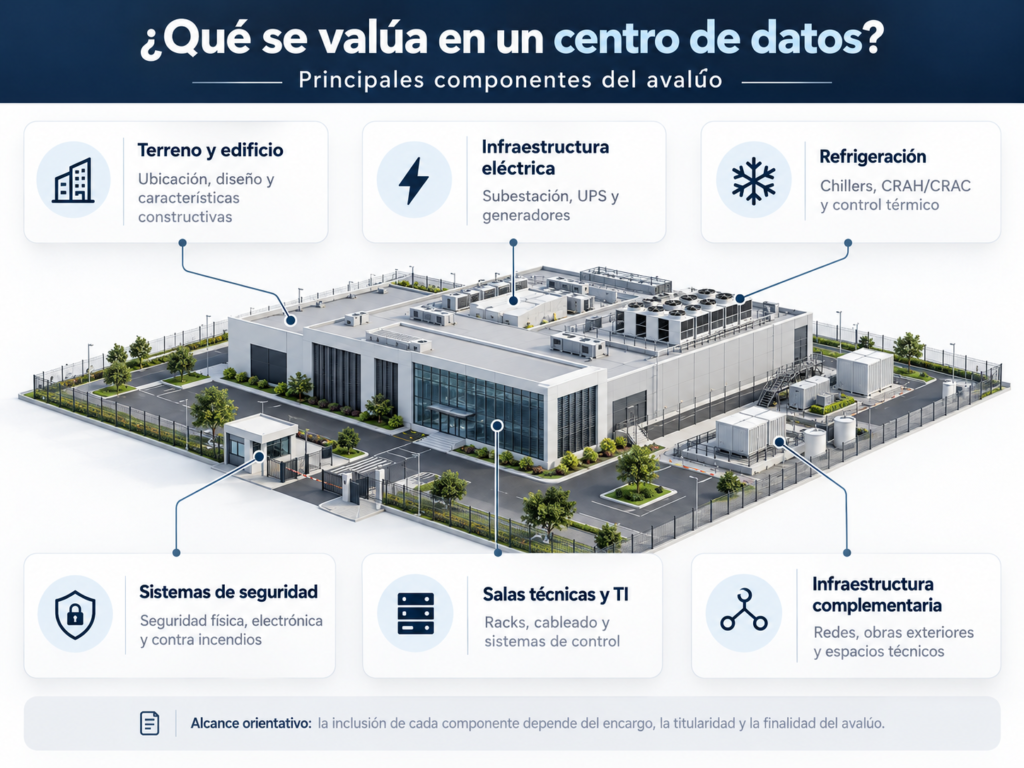
A data center houses both real estate and highly specialized movable assets. A technical analysis may separate: (1) land and building; (2) substations, transformers, UPS systems, and generators; (3) cooling, control, and security systems; (4) racks, servers, and networks, if they belong to the client and were included; and (5) contractual rights or business activities, when another type of valuation is expressly requested.
This classification is important because a colocation data center can host servers owned by third parties. It should not be assumed that all the equipment present belongs to the operator, nor that the business's revenue is included in the property's value.
Electrical capacity: MW contracted, installed and critical
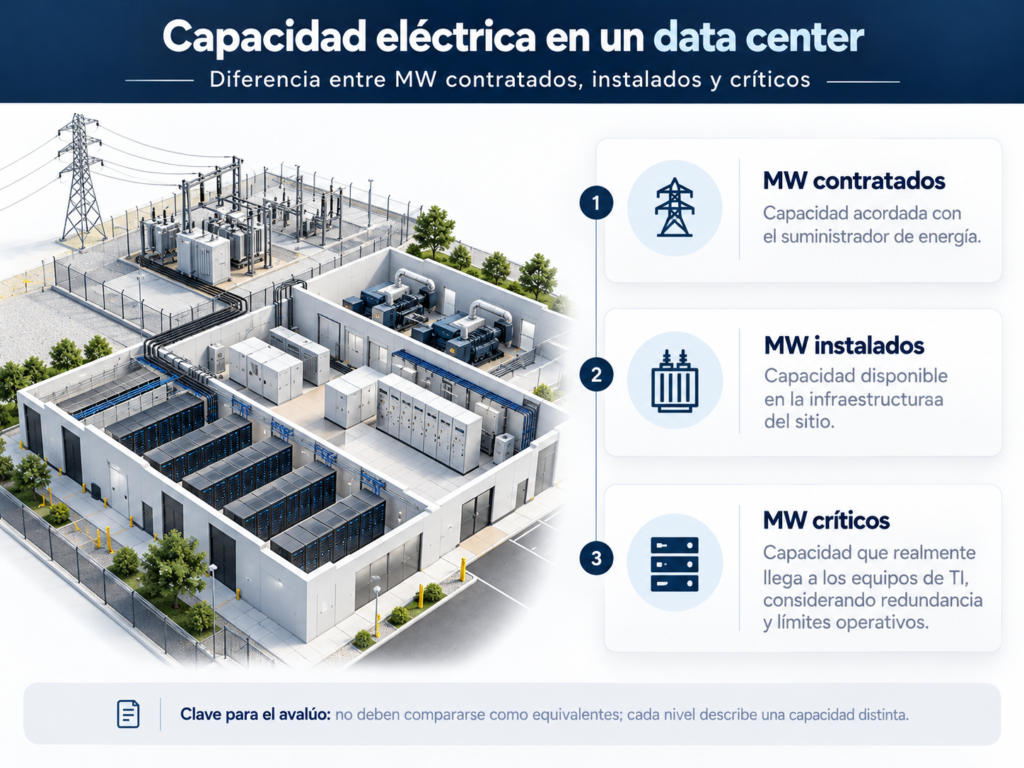
Energy availability determines what an installation can accommodate. To correctly interpret its potential, it's necessary to distinguish between the authorized or contracted supply power, the nominal capacity of its components, and the critical IT load permissible under defined operating conditions. These are different magnitudes: a substation with a certain power rating does not automatically equate to that same power available for servers.
The analysis may require a supply contract or feasibility study, single-line diagrams, transformer capacities and age data, switchboards, UPS systems, and generators, load tests, maintenance records, and evidence of operating limits. It is also important to confirm whether the expansion capacity is actually authorized or only shown on the plans.
A facility with high supply capacity may require backup or cooling investments before it can be converted into a usable critical load. Therefore, the value should not be calculated by indiscriminately multiplying the nominal MW by an average price.
Redundancy: why N+1, 2N and Tier are not synonyms
Redundancy describes how the installation can maintain its services when a component fails or is taken out of service. In an N+1 configuration, one additional unit is incorporated beyond the number required for a given function; 2N describes two complete sets for a defined function. Actual protection depends on the entire topology, not just the number of devices.
The Uptime Institute distinguishes four Tier classifications based on criteria such as topology, maintainability, and fault tolerance. Claiming that a data center is Tier III or Tier IV requires documentation and, if certification is involved, evidence of the specific certification. A design advertised as "equivalent to Tier III" should not automatically be considered certified.
In valuation, redundancy can increase the cost of reproduction or replacement and alter the utility for certain occupants. It does not necessarily imply a fixed and universal premium: the market, demand, and risks must be analyzed.
Cooling, rack density, and adaptation to artificial intelligence
It's not enough for a data center to simply have air conditioning systems. The technical evaluation must assess whether the cooling system is adequate for the actual computing load: thermal capacity, air or liquid distribution, redundancy, energy consumption, efficiency, and expansion margin.
Power density per rack and high-performance computing workloads may require different modifications than those for low-density installations. If new equipment is to be installed and the data center requires significant work on electrical distribution, cooling, or space, these costs and limitations can be included in the functional obsolescence analysis.
Power Usage Effectiveness (PUE) measures the ratio between the total energy consumed by a data center and the energy used by its IT equipment. For example, a PUE of 1.5 means that for every 1 kWh consumed by the IT equipment, the facility uses 1.5 kWh in total. In an appraisal, this indicator helps analyze efficiency and potential operating costs, but it does not, on its own, determine the property's value. It must be interpreted according to the measurement conditions and the operational load.
Connectivity, location and market in Mexico
The usefulness of an installation also depends on its connectivity: available operators, physical diversity of fiber routes, latency to target markets, and the possibility of contracting data transport services. The mere existence of several telecommunications companies does not guarantee independent routes if they share conduits.
Mexico has expanding digital infrastructure markets. In its Global Data Center Trends 2026 report, CBRE reported an inventory of 298.2 MW for Querétaro in the first quarter of 2026, compared to a year-over-year expansion of 450.2 MW. The report also recorded a vacancy rate of 10.6 MW. These indicators describe market and inventory, not the price or value of an individual data center.
For a given property, market research should consider energy availability and quality, local conditions, accessibility, risks, feasible expansion, comparable demand, and asset rights. High regional growth does not, in itself, justify increasing the valuation of every facility in the area.
What methods are used to value a data center in Mexico??
The methodology is defined according to the purpose of the valuation, the rights and assets included, the value base, and the available evidence. There is no single formula for a data center, nor is it mandatory to apply all techniques.
Cost approach: depreciated replacement cost (DRC))
The cost approach estimates the cost of acquiring equivalent utility infrastructure. Depreciated replacement cost (DRC) accounts for physical deterioration, functional obsolescence, and external economic factors where applicable. It is particularly relevant for specialized facilities with few suitable comparables, but should not be automatically chosen if the market provides sufficient evidence. Land, building, and included fixtures should be separated to avoid duplicating UPS systems, generators, electrical systems, or cooling systems.
Market focus: comparable transactions and USD/M indicatorW
The market approach analyzes comparable asset transactions and adjusts for differences in location, configuration, condition, stage of development, and included components. The USD/MW indicator can be used as a supplementary check when capacity is defined homogeneously—for example, critical operational MW. It is not an independent valuation method nor a standard rate for data centers in Mexico: requested power cannot be directly compared with installed and proven capacity.
Revenue approach: capitalization and discounted cash flow (DCF))
When valuing leased properties or income-generating rights, capitalization can consider stabilized rents and supported rates, while DCF projects cash flows with contracts, occupancy, operating costs, investments, and risks. In a colocation business, real estate income must be distinguished from energy or service revenue. The value of the operating business is not automatically the value of the property.
| Approach | Technique | Application |
|---|---|---|
| Costs | Depreciated Replacement Cost (DRC) | Specialized infrastructure, considering physical deterioration and obsolescence. |
| Market | Comparable transactions | Comparison of equivalent assets. USD/MW can be a comparative indicator, not an independent method. |
| Income | Capitalization and discounted cash flow (DCF) | Leased properties or income-generating assets, depending on the scope. |
| Projects in development | Residual method | Land and unfinished projects, using verifiable assumptions. |
Special case: residual method in projects under developmenteither
For sites or projects that are not yet completed, a residual analysis can consider the value of the planned development less costs, timelines, risks, and required performance. Its relevance depends on the verifiability of the assumptions and permits, including electrical availability. It is not a technique that can be applied by default to every existing data center.
How are the results reconciled?yes
If multiple techniques are applied, their results are interpreted according to the quality of the data and the purpose of the engagement. Values for property, infrastructure, and businesses are not automatically averaged or summed when there is overlap. For general reference, IVS 300 covers plant, equipment, and infrastructure; IVS 400, real estate interests; and IVS 200, businesses and equity interests.
Comparative example: same building, different usable capacity
Two facilities are 5,000 m² each. The first has a proven critical load of 2 MW, expansion limitations, and outdated cooling systems. The second has a verifiable critical load of 4 MW, documented telecommunications routes, and recent mechanical upgrades. These differences may affect replacement costs, profitability, and demand, but they don't allow us to conclude that the second facility is worth twice as much: market conditions, ownership, maintenance, revenue, obligations, and upgrade costs are still being considered.
Obsolescence doesn't just affect servers
Physical obsolescence occurs when equipment and systems deteriorate. Functional obsolescence arises, for example, when electrical or thermal topology prevents the incorporation of new equipment without significant investment. Economic obsolescence can be associated with external factors, such as supply constraints, market changes, or decreased demand. Automatic adjustments should be avoided, and the true causes of loss of utility should be documented.
What specific risks can decrease the value of a data center?
The requested power, the capacity with documented connection conditions, the energized infrastructure, and the critical MW effectively tested are not equivalent. Verifying contracts, feasibility studies, load tests, and interconnection costs prevents valuing an expansion that is still uncertain as available.
Outstanding capital expenditures (CapEx) for upgrading cooling and electrical distribution systems, water supply conditions (if required by the system), site physical hazards, and documented operational history should also be reviewed. Their economic impact depends on evidence; automatic discounts do not apply.
How do occupancy and contracts affect value?
In leased or colocation facilities, it's important to distinguish between built, available, contracted, and billed MW. Contract terms, customer concentration, energy cost allocation, SLA commitments, and replacement costs can all affect cash flows. IT service revenues should not be automatically confused with building rent.
What standards are considered for a data center appraisal in Mexico?
No Mexican Official Standard (NOM) was identified that establishes a specific valuation formula for data centers. NMX-R-081-SCFI-2015 offers a general Mexican reference for valuation services, but it should not be considered mandatory for all engagements. Depending on the purpose, specific rules from INDAABIN (National Institute of Federal Assets Administration), requirements from financial institutions, or accounting standards such as NIF C-6 (Property, Plant and Equipment), C-15 (Impairment), and B-17 (Fair Value) may apply.
For risk assessment and technical documentation, NOM-001-SEDE-2012 on electrical installations—listed as current in the official catalog consulted—and NOM-002-STPS-2010 on fire prevention and protection may be relevant. These standards are not valuation methods, nor does the appraiser's inspection replace a compliance verification. Tier classifications and TIA standards are industry-specific references, not Mexican NOMs for value calculation.
| Standard or framework | Application | Consideration |
|---|---|---|
| NMX-R-081-SCFI-2015 | General valuation methodology. | Mexican reference; not universally required. |
| INDAABIN | Valuation methodologies within their area of competence. | Application according to the purpose and type of order. |
| NIF C-6, C-15 and B-17 | Property, plant and equipment; impairment and fair value. | Relevant for certain accounting purposes. |
| NOM-001-SEDE-2012 | Electrical installations. | Technical reference; verify validity and applicability to the case. |
| NOM-002-STPS-2010 | Fire prevention and protection. | Security reference, not valuation method. |
| IVS / Uptime Institute | Infrastructure valuation and classification standards, respectively. | International references of different natures. |
What information is needed to start an appraisal?
- Objective of the study, value basis, valuation date, requesting entity and ownership of the assets.
- Deeds, as-built drawings, surfaces, applicable permits and scope of permanent installations.
- Electricity supply contracts or feasibility studies, single-line diagrams, measured critical load and actually available power.
- Inventory of UPS, transformers, generators, chillers and other assets; acquisition and maintenance dates.
- Documentation on redundancy, testing, Tier certifications if available, and efficiency/temperature measurements.
- Fiber optic route map and operators; expansion restrictions and anticipated modernization costs.
- Rental, occupancy, income and expense contracts only if the order includes economic rights or operation.
Why might you need a data center appraisal?
A valuation can support transactions involving buying and selling, financing, insurance, financial reporting, asset reorganization, or estate planning decisions. However, each purpose may require a different valuation basis, scope of documentation, and professional qualifications. Insurable value, market value, and business value are not equivalent by definition.
Frequent questions
Are external client servers included?
Not by default. Ownership of the equipment must be verified and its inclusion in the scope of the appraisal must be expressly agreed upon.
Is a Tier III data center worth more than one without certification?
Ratings and certifications can influence a product's commercial appeal, but there is no fixed premium. Their impact must be supported by technical and market analysis.
Can the value of a data center be estimated per MW?
The monetary indicator per MW can be used as a comparative reference, provided that critical capacity, location, included infrastructure, and operating characteristics are considered. It does not replace a comprehensive valuation.
Who should review the valuation of a data center?
A valuation professional with expertise in the assets included, supported where appropriate by specialists in electrical engineering, mechanical engineering, technological infrastructure and legal documentation.
Do you need a data center appraisal in Mexico?
At ANEPSA Mexico we can evaluate your project requirements and determine the appropriate valuation scope for the property and its specialized facilities.
Request scope assessment ↘